A Historical Essay Written for the Butte Historical Society
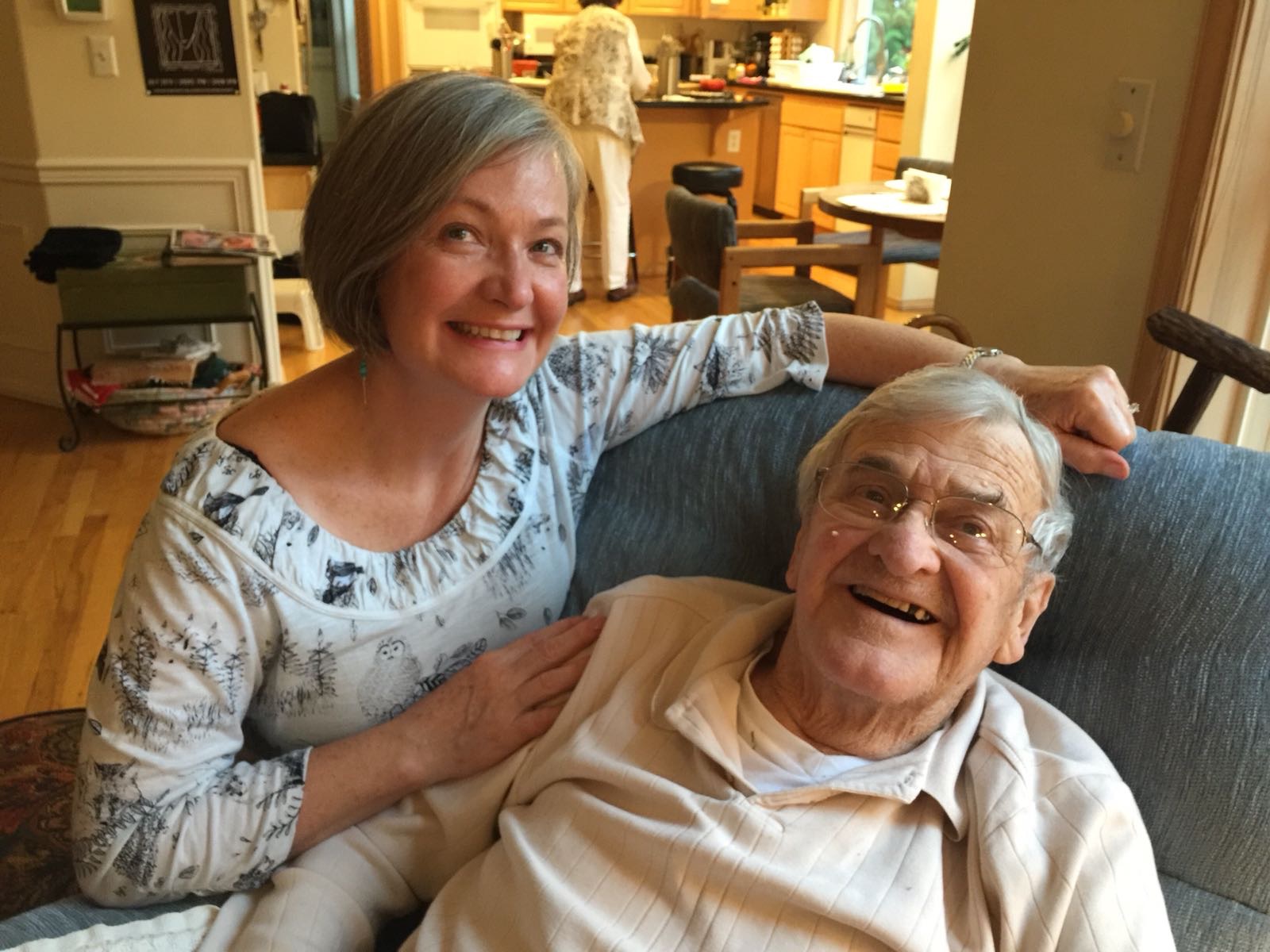
“It’s a long way from Jefferson Street,” dad remarked on that August afternoon in 2017 as he stared out the car window, waiting for mom to shop at the busy Bartell Drugs in North Bend Washington. This was not just some random observation from a eighty-three year old man in declining health; comparing places to his cherished home in Butte Montana was a common thread he’d sew throughout his life.
Mom and him left Butte some 60 years earlier, but till the end of his life, when dad introduced himself, he’d shake hands as if gripping a miner’s pick and announce, “I’m Frank Ambrozic from Butte Montana.”
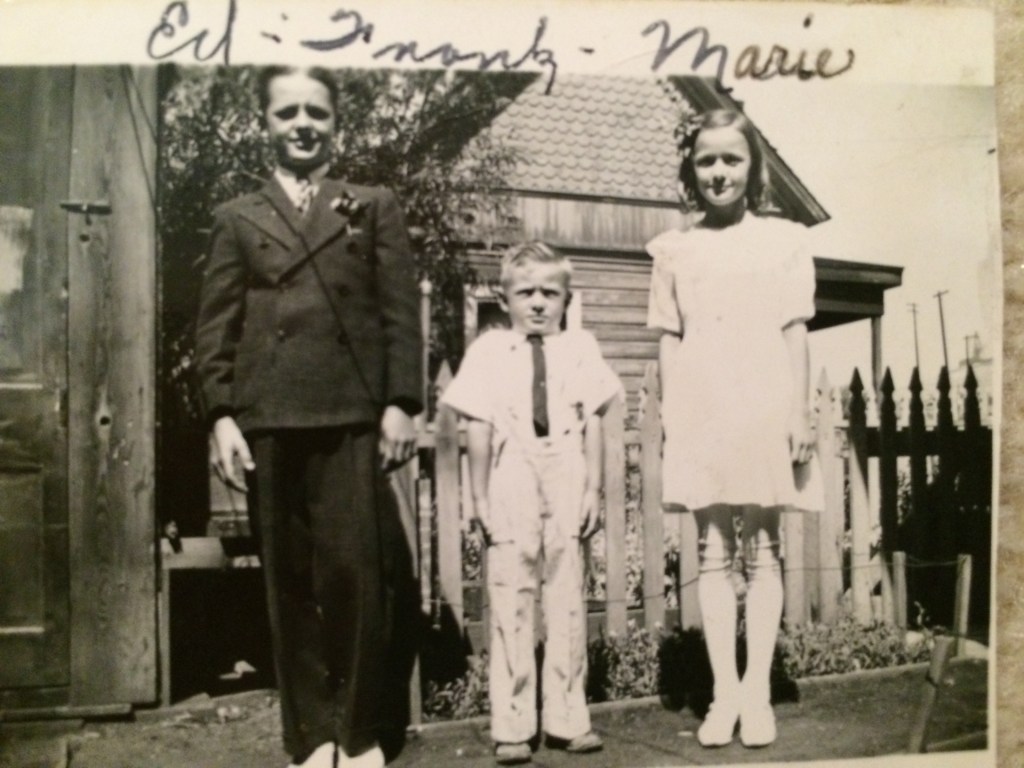

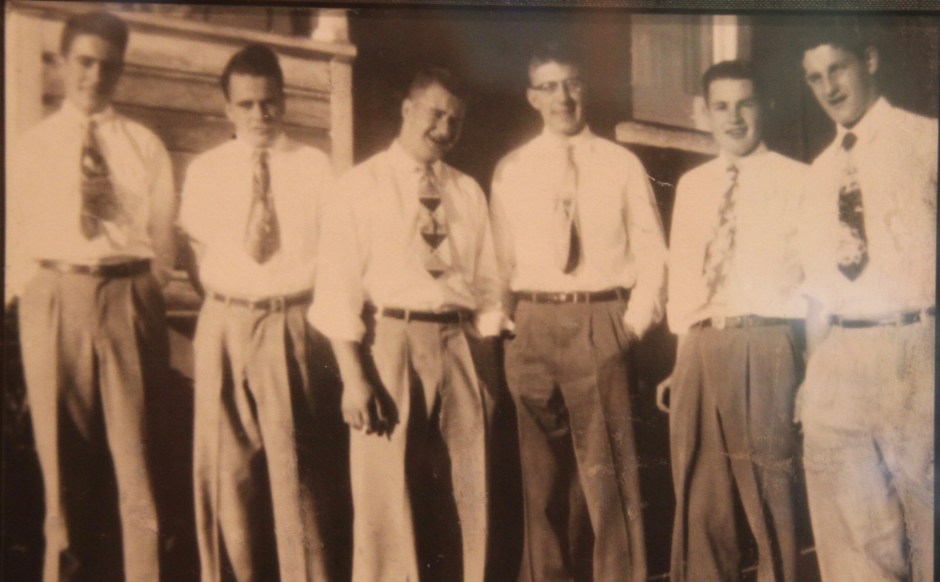
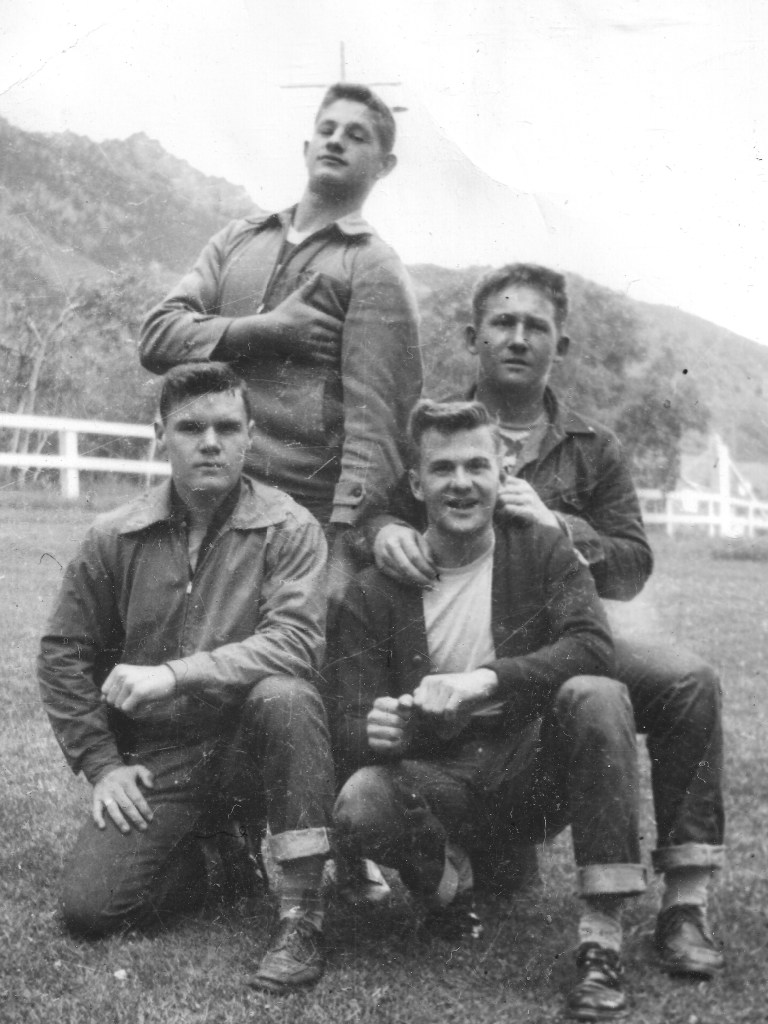
Back Ed Ambrozic, Louie Loushin, Joe Kastelitz, Willie Pozar. At the Wheel: George Krstulich (photo credit George Krstulich).
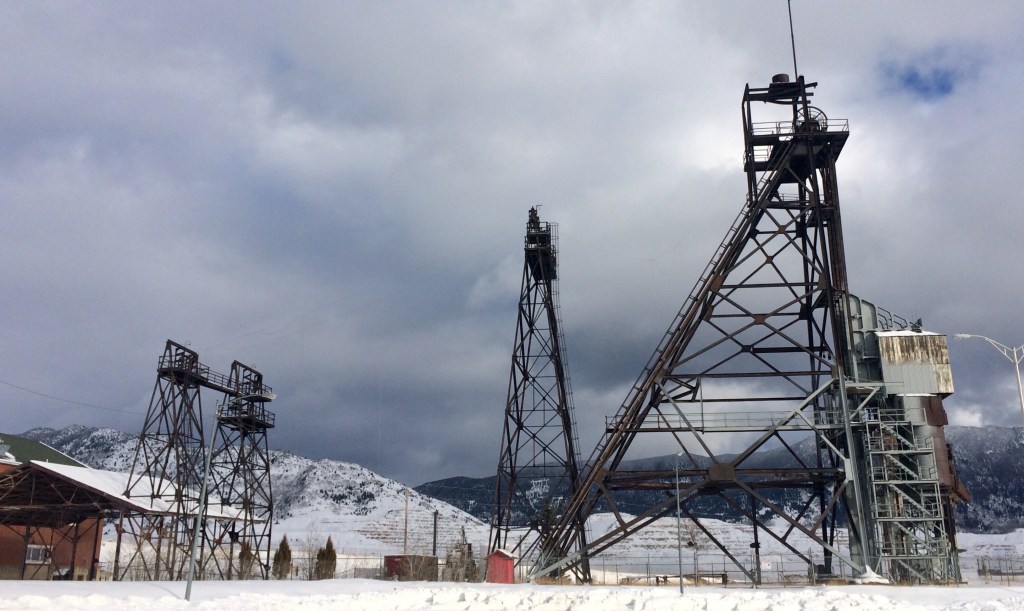
Dad grew up in the Parrot Flat – one of Butte’s mining communities wiped from the face of the earth by the Berkley Pit. He lived there from 1934 to 1957. I was too young to remember the Parrot Flat, but my father’s reminiscing brought the place alive. The people of the Parrot Flat influenced my father’s understanding of family values and brotherly love. His hometown shaped his perception that humankind was made up of kind humans. “People respected each other and they had each others backs,” he would tell me, “friendships were as rich as the ore they mined.”
This was dad’s hometown: he was born in St James Hospital, baptized, confirmed and married at Sacred Heart Church, he attended Jefferson Grade School and Boys Central.
From a family of immigrant Slovenian miners, dad was a part of a generation who did not want to mine Butte’s mile-deep veins like their fathers and grandfathers did. Mom and dad were part of a mass exodus of young men and women in the late 1950s that moved to Seattle to pursue new opportunities for their family. Saying goodbye to his beloved neighborhood was difficult for dad. Mom said Dad’s eyes were so full of tears when they began to drive away that he sideswiped a parked car.
The Parrot Flat was home to Croatian and Slovenian immigrant families who sought camaraderie and commonality in a new country. Named after the Parrot Smelter which operated in the area prior to the start of the 20th century, the Parrot Flat neighborhood was located just south of the Belmont Mine below East Mercury Street. The East Side sat directly northwest of the Parrot Flat; Meaderville was a short distance away to the east, and Butte’s Flats was off to the South. “1
My father was the third generation of his family to call the Parrot Flat home. In 1892, at the age of twenty-three, my great-grandfather, Frank Ambrozic, immigrated to Butte from Austria (which became Suhor Slovenia) to find work as a miner. He married my great-grandmother, Angela Gnidica – another (Austrian) Slovenian immigrant – and they set up house at 1314 Gallatin Street. They had four children, including my grandfather, Edward Ambrozic.

Angela died of meningitis in 1903 after the birth of their fourth child. Unable to care for them, Frank put the children in the Sisters of Charity Orphanage in East Helena and returned to Suhor. After remarrying, he returned to Helena to retrieve his children and raise them with his new wife in the old country.
In 1921, at the age of twenty, my father’s father Edward returned to his place of birth. After receiving his Recommendation Card from Butte Mutual Labor Bureau, he began a career of mining at the Granite Mine. He married Ann Clements, the daughter of another Slovenian immigrant mining family in 1927 and they purchased a home at 301 Watson Avenue. They had three children, the youngest being my father Frank.


Times were relatively happy for the young family until tragedy stuck in 1933. At the age of thirty-two, Edward was hurt in a Granite Mine cave-in. Rheumatoid Arthritis settled into his legs and he became a cripple, confined to a wheelchair until he died in 1952. My dad never saw his father walk.
My grandmother, a mother of three small children, was now also a full-time caregiver to her crippled husband. They lived off some meager financial assistance – I’m not sure if it was from the Anaconda Copper Mining Company or the government, my father never said. But after a few years, the opportunity to purchase a small grocery store in the Parrot Flat, on the corner of Kemper and Jefferson Street, presented itself.
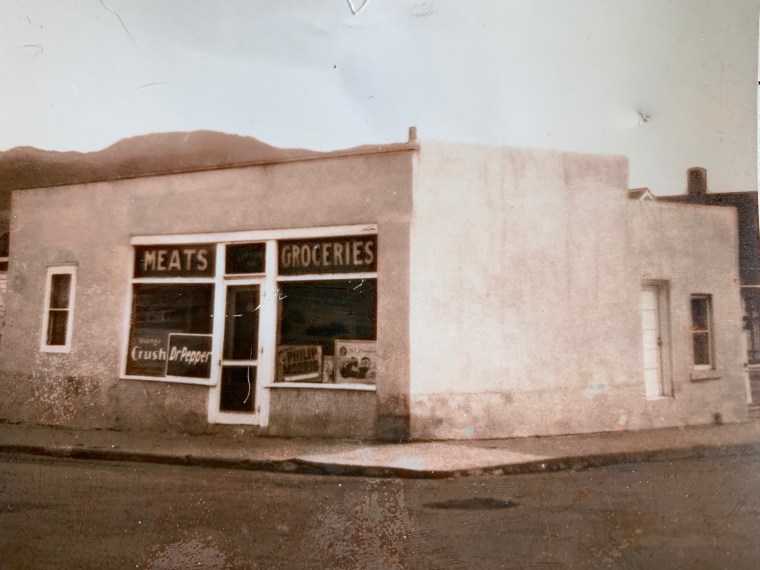
They sold their home and purchased the Parrot Grocery at 1200 Jefferson Street. They moved into the cramped quarters of a three-room dwelling behind the store. Grandma became the wage earner for the family.
This was my father’s home; he grew up helping her in the store. “Things were tough,” dad said. But he never sought pity because he understood there were many others around him who struggled just as much. “Everyone had to work very hard to get anything they had,” he’d add, “people had a very good work ethic: they had no choice!” The families of the Parrot Flat had to rely on the support of their neighbors in order to survive. And the community did not let them down.
While there were stories of hardship, the ones of happy times and camaraderie were the stories dad loved to tell the most. An eloquent orator, his stories of everyday events were told with pride. He’d sit up tall and cock back his shoulders as he began. His eyes would open wide when he got to the funny parts. Halfway through his story, overcome with emotion, his voice would get higher. He’d tap his finger loudly on the table to emphasis points of his story.
We’d gather around him like children waiting to hear a favorite fairytale, hanging on his every word as he’d recall the good times with friends and families of the Parrot Flat with tongue-tying names like Brozovich, Evatz, Govednik, Kastelitz, Kochevar, Krstulich, Kump, Lanch, Loushin, Markovich, Popish, Pugel, Sagar and Simonich.
It’s common knowledge that Butte Montana was built on the backs and by the hands of miners, but the stories that shed light on the nuances of those miner’s lives outside the depths of the mines are rarely heard. One of dad’s favorites, the one that encapsulates the spirit of a neighborhood, of a time and of a place that no longer exist, is the story of the Suit Club from Koochy’s Bar. Over the years, I’ve written it down 7 times as he told it, grasping for any random piece of paper I could find in order to record it and not forget any of its heart-warming details.
The Suit Club
Koochy’s Bar was a small bar on the Parrot Flat on the corner of Watson and Gallatin, at 436 Watson Avenue. It was owned by Joe and Frances Kochevar. Like many of the families who lived in the Parrot Flat, Joe and his father Anton immigrated from Slovenia in the 1920s to work in Butte’s mines.” “2
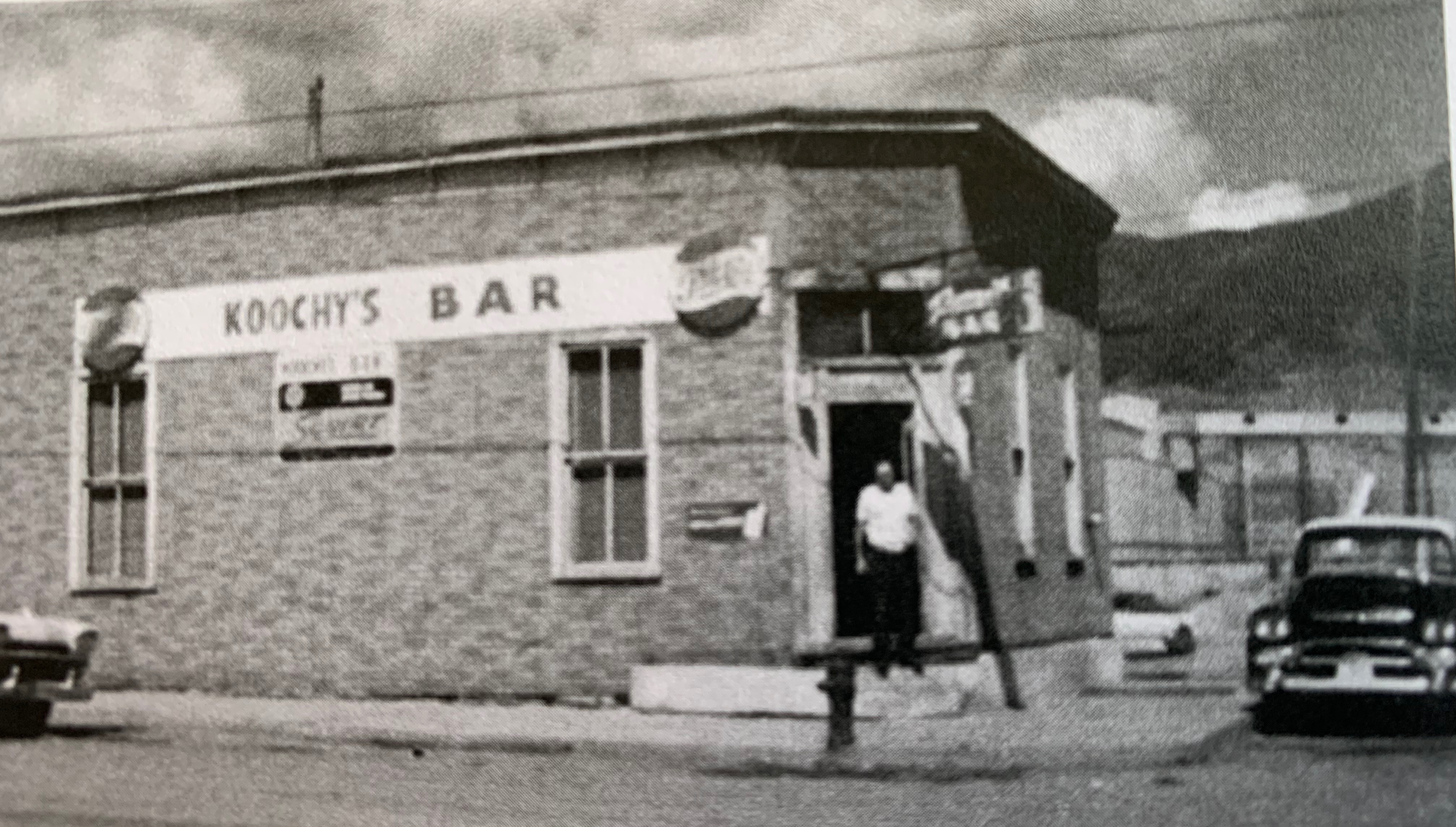
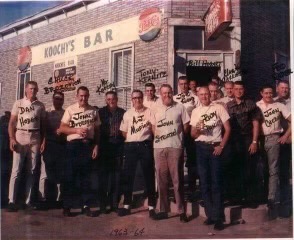
The Kochevars were close friends of my father’s family. Joe’s son Eddie was one of my dad’s best buddies; Joe Kochevar was a pallbearer for my father’s father Edward when he died in 1952.
Joe, or “Koochy” as his friends called him, bought the Parrot Flat Bar in 1940 and renamed it Koochy’s Bar. Joe Kochevar ran the bar for 30 years until the Anaconda Company bought him out for the expansion of the Berkley Pit. “3
George Krstulich, a good friend of my dad and his older brother Ed once recalled; “I remember a glass of beer only costing a dime at Koochy’s. They kicked back a beer after every third drink so you really never needed much to have a good time at Koochy’s.” “4
He was also known for being loose with his whisky. Dad asked him, “Koochy, how the hell do you make any money, the guys are drinking dime beers and you’re giving away shots of whiskey?” Koochy replied, “I can’t stand those dammed dime beers!” Joe told dad it was too much work to draw the beer, walk the bar and hand it to them. He’d rather just slide the whisky bottle down to them and let them take a shot for free.
Koochy’s was a favorite gathering place for the Eastside miners who’d come in after a long day in Butte’s mines. But this was no ordinary bar, and Koochy was no ordinary bar owner. The miners were not just customers, they were friends to Koochy and he knew them all by their first name.
On payday, the miners would come into Koochy’s to cash their paychecks. Once they had their hard-earned money in hand, they’d give Koochy a quarter or fifty cents and say, ”this is for my suit.” Koochy would reach behind his cash register and pull out an IOU book labeled, “Suit Club.” He’d record their deposit in the book, place a receipt in their black stained hands and they’d tuck it away in their dusty overall pockets.
Joe Kochevar had a deal with Wein’s Men’s Store in Uptown Butte. It took many years, but when the miners had fifty dollars on deposit with Koochy, he’d call up Wein’s and let them know the minor would be coming to see them. “Fifty dollars was a lot of money in those days,” dad would emphasize as he tapped his finger on the table.
On Saturday morning, the old miner would make the trip up to East Park Street to Wein’s Men’s Store. This would be the first and last time they would patronize the upscale men’s clothing store.
With their $50.00 deposit called in by Koochy, he would get treated like a king. The store clerk would welcome him in and fit him for a new tailor-fit suit. He’d proceed to pick out a crisp white shirt, a matching tie, new shiny shoes, stockings and even a dapper hat. This suit would be the only one the miner would own.
Later that afternoon, the miner would return to Koochy’s Bar, freshly scrubbed, showered and shaven, wearing his new pressed suit, “looking like a million bucks,” dad said.
Standing tall as a Butte headframe, he’d enter the bar and every eye in the joint took notice. Slowly, the miner would saunter up to the bar, pull up a stool and sit down. Koochy would happily greet him asking, “How you doing today?” The miner would puff out his chest and reply, “Doing just fine Kooch, just fine!” Koochy would buy him a beer and the miner would look around the room “proud as hell.”
“It was a real ceremony and the men relished their moment,” dad would tell us with his high-pitched voice.
All would admire the man before them, buying him drinks and showering him with compliments of how nice he looked and how well he cleaned up. But not a word was mentioned about his suit for this was an acknowledgement that need not to be vocalized. Everyone knew, that the man was now an official member of the Suit Club, a club you entered alone.
The minor would wear the suit just that one time. After the day was over, he’d return home, carefully take the suit, the shirt, the tie, the socks, the shoes and the hat off and neatly place them back in the sturdy box the ensemble came in and store it away.
But he didn’t put it in a closet, a chest, under a bed or in the garage. The next day, the miner would carry it to the local funeral home and ask them to safely store it for them. The box never saw the light until the day the miner died. This was the suit they would be buried in.
The Suit Club is a story of one man whose kindness touched many. Joe Kochevar cared about those hard-working Eastside miners. He gave them recognition. He took time to assure them their sacrifice and struggle mattered, that their life mattered, that they could rest in peace when they died knowing they would be buried with dignity.
Stories form the basis for how we think about the world and live our lives. My father’s stories were his identity. Growing up in the city of Seattle, I don’t have those types of cherished memories. But I have his. While I never lived in Butte, his stories make me feel like I’m part of the community – they’ve given me my identity. I feel lucky to have them.
The Suit Club and the Parrot Flat neighborhood help illustrate the fiber of Butte, of a community intentionally woven together to support one another. In this day and age, people have become isolated: We don’t make eye contact, we don’t acknowledge strangers, we certainty don’t know our neighbors. Neighborhoods are dying off like this great generation of men.
While neither the men, nor the bar, nor the neighborhood exist anymore, it’s my hope that by giving this story back to Butte, the spirit of my father and the Parrot Flat, of what it means to be a neighbor and a neighborhood, will live on just a little bit longer.

Bibliography
Kearney, Pat. Butte Voices: Mining, Neighborhoods and People. Skyhigh Communications. Butte, Montana. 1998.
Simonich, Ann Stajcar. Butte’s Croatian Slovenian Americans.
Butte, Montana. 2012.
Ambrozic, Frank Louis. Quotes from my father.
Butte, Montana. 1934 -2019.
Notes
1. Pat Kearney, Butte Voices: Mining, Neighborhoods and People (Skyhigh Communications. 1998). 223.
2. Ann Stajcar Simonich, Butte’s Croatian Slovenian Americans (Butte, Montana. 2012). 55.
3. Ann Stajcar Simonich, Butte’s Croatian Slovenian Americans (Butte, Montana. 2012). 55.
4. Pat Kearney, Butte Voices: Mining, Neighborhoods and People (Skyhigh Communications. 1998). 223.
 A Camper and Some Change
Cheryl dear, that was just beautiful, Al and I remember some of the stories about Butte that your father would tell us as we also sat around talking and having that glass of beer. I am so glad I ran across this today. I just so happen that I had a nice talk with your Mom today. Love Jennie and Al
LikeLiked by 2 people
Thanks Jennie, love you and big Al!! Thank you for calling ma, she considers you one of her closest friends! Here’s to dad!
LikeLiked by 1 person
Great essay, Cher. Really enjoyed reading this!
LikeLiked by 2 people
Dear Sweet Little Sister Cheryl, you have captured the spirit and essence of our Dad’s storytelling perfectly. You are carrying the tradition forward so future generations can enjoy and savor a bygone era where, as Dad and you so eloquently stated, “a belief that humankind was made up of kind humans”. That is trait both of you possess. Folks remember to have a box of Kleenex or a “hanky” on hand when reading the “Suit Club”.
I can still hear Dad’s voice go up an octave or two at the tender parts of the story and his finger tapping on the table for emphasis. Thank you so very much for keeping the story alive. And the pictures are wonderful and evocative. Dad is surely beaming now and all teared up to be sure from his perch above us, knowing that his storytelling legacy is continuing. I look forward to more. Thank you Cheryl!
LikeLiked by 1 person
Great story from Uncle Frank and very well written! Thank you for sharing this!
LikeLiked by 1 person
Cheryl, thank you for that fulfilling history! It’s wonderful to again hear our family names, memories and originations, many for my first time. My wife Tricia and I have raised our kids Jay and Alexandra (Alex) in a mining community here in Morgantown West Virginia, a very proud community with similar immigrant mining roots. Thank you again! I hope to follow your blog and exciting new journey! Guy Shelledy
LikeLiked by 1 person
beautiful! World’s Largest Electric Vehicle Factory Opens in Germany 2025 select
LikeLike